 Around the House
Five of This Tea's Twelve Plants Are Already in an Ordinary Kitchen Cupboard
The rest belong to an Indian grocer's shelf, a city street tree and a windowsill pot. Here is what each brings to one teaspoon of loose leaf, and what its research actually used.

This is a paid advertisement. Sponsored by Herbkart Commerce Inc.

Open the spice cupboard in almost any American kitchen and you will find the same short row of jars.
Cinnamon, ginger, turmeric, a bit of rosemary for the roast, and somewhere behind them a box of green tea bought for a reason nobody remembers.
I bring up that cupboard because of a tin of loose-leaf tea from India that crossed my desk this month.
Its ingredient panel prints twelve names, and five of them are sitting in that row of jars right now.
The other seven are a different matter.
Five belong on the shelf of an Indian grocer, one grows on city sidewalks, and one lives in a pot on the kitchen windowsill.
Five you know by smell. Seven you would have to go looking for.
That split is the most useful way I have found to read this tin.
It tells you which part of the cup you already understand, and which part you are paying to have shipped from the other side of the world.
Walter Ainsley is the byline this desk writes under.
What this page says about the tin comes from the seller's own listing and its photographs, and from the seller's contact, shipping and returns pages, read on September 21, 2026.
The seller's listing shows no customer reviews, so this page quotes none.
The people in the photographs are illustrations, not buyers.
The tin is a 100-gram round of loose green tea blended with herbs, roots and spices.
It is packed in Kolkata and sold from Chennai, and it asks you to steep one teaspoon in a cup of boiled water, covered, for three to four minutes.
It prints no amount for any of its twelve plants.
Not one figure, for any name, anywhere on the tin.
That single fact shapes everything else on this page, so I will keep coming back to it.
A jar in your cupboard at least tells you what is inside it; this tin tells you what is inside, and never how much.
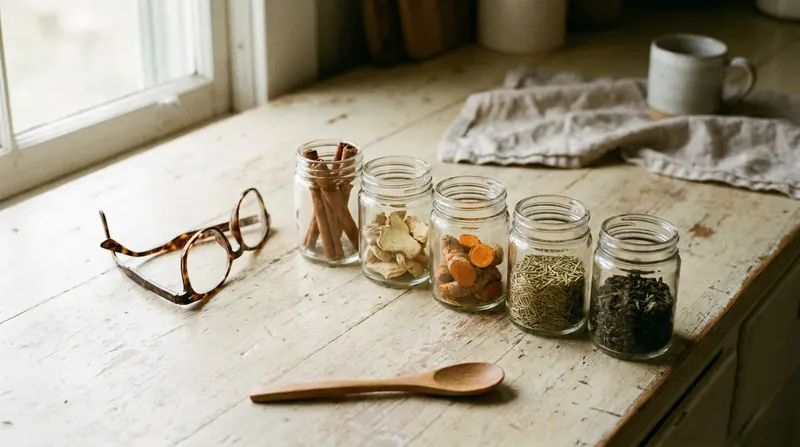
So here is how this page will go, laid out plainly before the long part.
First, the five you already own.
For each I will say what it adds to the cup and what, if anything, has been studied.
Then a plain question any cook would ask: could you brew that familiar half yourself, tonight, from your own jars?
I will answer it honestly, even though the answer does not flatter the tin.
Second, the five from the Indian shelf.
These are the plants the tin is really built around, and two of them have the best research in the whole blend.
Third, the street tree and the windowsill plant, which are the oddest two names on the panel.
One of them is printed on the front of the tin, and its largest trial is the one you most need to hear about.
Then the rest of what a buyer asks.
How far a teaspoon goes, how the tin wants to be stored, who sells it, and what happens if the parcel arrives wrong.
One sentence to carry through all of it: the studies on these plants used concentrated extracts, and this is a tea.
That is not a small print point.
It is the difference between a measured dose swallowed in a trial and a cup of hot water that sat on a spoonful of leaves for four minutes.
I am not going to pretend the difference away.
I am also not going to pretend a hot spiced cup at the kitchen table is worth nothing, because it plainly is worth something.
The job here is to put each name on the tin next to what is actually known about it, and let you decide.
Twelve Names, Sorted the Way a Cook Would Sort Them
The panel prints its ingredients in one line, in this order.
Organic green tea, ginkgo biloba, gotu kola, amla, rosemary, brahmi, aloe vera, holy basil, ginger root, ashwagandha, cinnamon and turmeric.
Read that line as a list of plants and it blurs together.
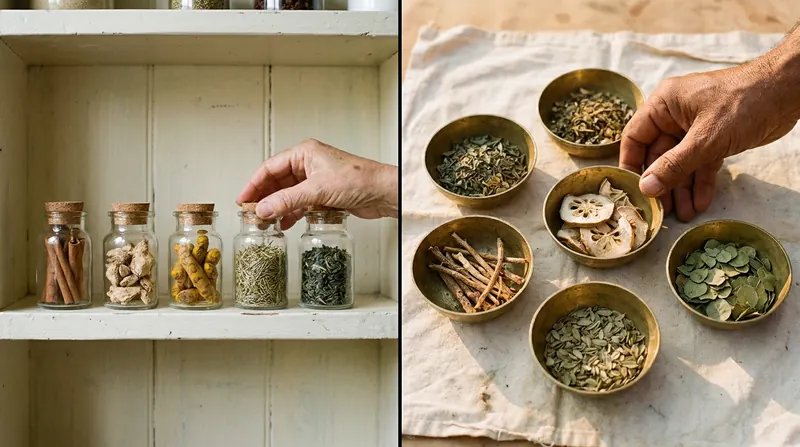
Read it as a cook standing at an open cupboard and it falls into three piles almost by itself.
The first pile is what you already own.
Green tea, rosemary, ginger, cinnamon and turmeric are on the shelf of any supermarket in the country.
The second pile is the Indian shelf.
Holy basil, amla, ashwagandha, brahmi and gotu kola are household plants in India and unfamiliar almost everywhere else.
The third pile is two strangers.
Ginkgo is a tree you have walked past on city streets, and aloe vera is the spiky plant people keep by a sunny window.
That sorting matters for a reason beyond tidiness.
The familiar five tell you roughly what the cup will taste and smell like before you ever open it.
Green tea gives the body of the drink, and the caffeine.
Cinnamon and ginger give the warmth that anyone who has had a cup of chai will recognise.
Rosemary adds a resinous, piney note, and turmeric a faint earthiness and a golden tint.
None of that is a promise; it is simply what those plants do to hot water in every kitchen they have ever been used in.
The listing on the seller's site says, in its table of details, "Scent: None."
A blend with cinnamon, ginger, rosemary and holy basil in it is unlikely to smell of nothing, but I have not opened this tin, so I leave that line where the seller put it.
The Indian five and the two strangers are what make this blend different from anything you could put together at home.
They are also where the tin's research lives, and where the honest answers get more careful.
One more thing about order before we start.
Ingredient lists on food are printed from most to least by weight, so green tea being first means it is very likely most of what is in the tin.
The panel does not confirm that with a figure.
It is the ordinary reading of an ingredient list, and I will read it that way and no further.
The Cupboard Five, Starting With the Box at the Back
Green tea is the first name on the panel and the one most kitchens already have.
It is also the one that decides what kind of drink this is.
Green, black and oolong tea all come from the same plant, Camellia sinensis. [1]
The difference is in the processing: green tea is dried without the step that turns the leaves dark.
That means a cup of this blend is, first and foremost, a cup of green tea.
The eleven other names are sharing whatever room is left in the spoon.
And green tea contains caffeine. [1]
The tin does not print how much.
I want to be plain about that, because it is the single most practical fact on this page.
A buyer choosing a drink for the afternoon or the evening needs to know whether it carries caffeine, and this one does.
For scale, the Food and Drug Administration cites 400 milligrams of caffeine a day as an amount not generally associated with negative effects in most healthy adults. [2]
That is roughly two to three twelve-ounce cups of brewed coffee.
The European Food Safety Authority reached a similar place in 2015. [3]
It put single doses up to 200 milligrams, and daily intakes up to 400, inside the range that does not raise concerns for healthy adults.
A cup of green tea sits well below those lines.
But it counts toward them, and a man who already drinks three coffees should count this cup in the same total.
Take every cup of this blend as a daytime cup, and count it with your coffee.
Green tea also brings a small amount of an amino acid called L-theanine.
It is the reason tea drinkers often describe the lift from tea as different from the lift from coffee.
The research on L-theanine is small, but it exists, and some of it was done in people close to your age.
In one Japanese study of adults aged 50 to 69, a single dose was followed by a faster reaction time on an attention task and fewer errors on a working-memory task. [4]
The summary of that study does not give the dose in milligrams or the number of people.
Its authors worked for a tea company, which is worth knowing and not a reason to throw the result away.
A second study gave 30 healthy adults, average age 48, 200 milligrams of L-theanine a day for four weeks. [5]
Their scores on word fluency and on planning tasks were better than on placebo, and two of the authors worked for the company that supplied the ingredient.
Then there are the catechins, the other compounds green tea is known for.
In a study of Japanese adults aged 50 to 69, a single 336-milligram dose of decaffeinated green tea catechins reduced errors on a sustained-attention test. [6]
Twelve weeks of the same daily amount shortened response times on a working-memory task in that study.
Again, the doses were measured, and they came in a concentrated form.
One small trial looked at caffeine and L-theanine together, which is what a cup of green tea actually contains. [7]
Twenty-seven healthy volunteers took 50 milligrams of caffeine with 100 milligrams of L-theanine, and did better on an attention-switching task an hour later than on placebo.
That pairing is the nearest thing in this whole research file to what happens in a teacup.
It was still a measured dose, taken once, in young volunteers, and nobody has measured how much of either compound a cup of this blend delivers.
The National Institutes of Health adds two cautions about green tea that I would not leave off any honest page. [1]
Harm to the organ that processes what you swallow has been reported in some people, mostly with concentrated extracts in capsule or tablet form rather than with the drink.
And green tea can make some things people take every day work less well.
The agency names three by name, and a pharmacist can tell you in a minute whether anything in your cabinet is among them.
If you take anything daily, show the tin to your pharmacist before it becomes a daily cup.
That is the first of the cupboard five, and the most important.
Everything else on the panel is, by the ordinary reading of an ingredient list, a smaller share of the spoon.
Rosemary, the Roast Herb With the Closest Study to a Kitchen Amount
Rosemary is the fifth name on the panel and the most familiar one after green tea.
It is the needle-leaved shrub from the Mediterranean coast that goes on lamb, into bread and over roast potatoes.
It has also been tied to memory for a very long time.
In ancient Greece students were said to wear it while studying, and in old English custom it was the herb of remembrance.
Folklore is not evidence, and I would not bring it up if rosemary had nothing else.
It does have something else, and it is the one study in this whole file that looks anything like a kitchen.
Twenty-eight adults with an average age of 75 took part in a small crossover trial. [8]
On different days they were given plain dried rosemary leaf in several amounts, or a placebo.
At 750 milligrams, an amount close to what a cook might use, their speed on memory tasks was faster than on placebo.
At 6,000 milligrams, eight times as much, the effect went the other way.
The small dose helped speed, and the large dose hurt it: a stronger cup is not a better cup.
That result tells you two things at once.
The first is that a plain dried herb, at an ordinary amount, did something measurable in older adults.
The second is that more of it did not do more.
If anything, the trial argues for a modest spoon and against the instinct to double it.
Now the careful part.
That was a single dose, eaten as dried leaf, in 28 people, and the effect was measured over hours, not months.
And the rosemary in this tin is one of twelve names sharing a teaspoon.
I cannot tell you how many milligrams of it end up in your cup, and nor can anyone outside the company.
What I can say is that rosemary is the one plant on the panel where the studied form and the tea form are close cousins.
Dried leaf in a trial, dried leaf in a tin.
That is more than any other name on this panel can claim, and it is still only a small study.
Ginger, the Warm Note in Every Cup of Chai
Ginger root is the ninth name on the panel and the knobbly root in the vegetable drawer of half the country.
In this blend it appears as dried pieces of root.
It is the warming note in Indian chai, and it will be one of the first things you taste in this cup.
That warmth is the whole of what I can honestly credit it with here.
The research on ginger is about the stomach, mostly about nausea, and about joint comfort.
I found nothing on memory or attention that I would put in front of you.
I will not stretch a stomach study to cover a question it never asked.
Ginger is in the cup for flavor and for tradition, and that is a perfectly good reason for a spice to be in a tea.
A few people find ginger unsettling in quantity: heartburn, a loose stomach, a scratchy throat.
In a dried slice sharing a teaspoon, that is unlikely, and it is still worth noticing how the first week goes.
Ginger may also add to the effect of anything you take to thin the blood.
That is one more reason, alongside the green tea, to let your pharmacist see the tin.
Cinnamon, and the Question of Which Cinnamon
Cinnamon is the eleventh name on the panel and the one I would bet is already open in your cupboard.
It is the dried inner bark of tropical trees, sold as rolled quills or broken chips.
What most people do not know is that there are two kinds.
Ceylon cinnamon, sometimes called true cinnamon, comes mainly from Sri Lanka and rolls into thin, papery, many-layered quills.
Cassia cinnamon is thicker, darker and harder, rolls into a single rough curl, and is the kind most often sold in North America.
If the jar in your cupboard does not say which it is, it is very likely cassia.
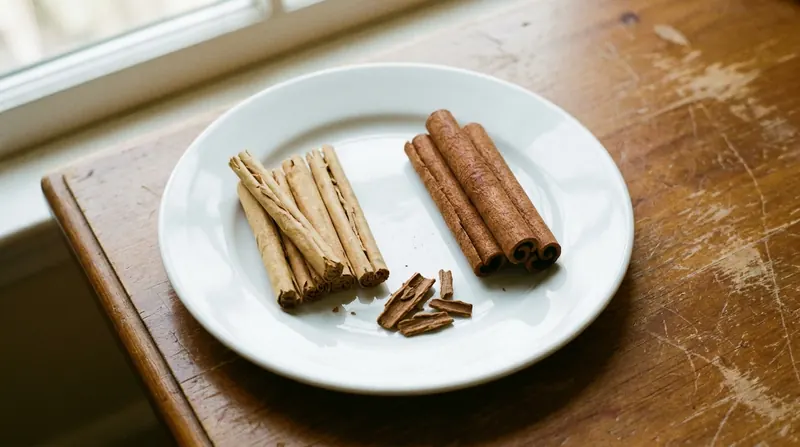
The tin does not say which kind it uses.
That matters for one practical reason, and it has nothing to do with memory.
Cassia carries a compound called coumarin, and a lot of it over a long time is a concern for the organ that processes what you swallow.
Ceylon carries only a trace.
A chip of bark in a daily cup is not an alarm.
It is simply one more question the tin leaves unanswered, and one more item for the pharmacist conversation if you take anything daily.
On memory and attention, I have nothing to cite for cinnamon.
It is in the cup for the smell of a bakery on a cold morning, and I will leave it at that.
Two of the cupboard five so far with a study worth naming. Two for flavor alone.
Turmeric, the Golden Root With a Patented Trial Behind It
Turmeric is the last name on the panel, the twelfth.
It is the orange-yellow root of a plant in the ginger family, dried and ground into the spice that colors curry.
In this blend it appears as small dried pieces.
The compound that gives it its color is called curcumin, and that is what most of the research is about.
There is one trial on curcumin and memory in older adults that gets quoted a great deal, and it deserves a fair reading.
Forty adults aged 51 to 84 took a highly absorbable form of curcumin, 90 milligrams twice a day, or a placebo, for eighteen months. [9]
The curcumin group had better scores on verbal memory, visual memory and attention than the placebo group.
Eighteen months is a long trial, and that is a genuine result.
It was also a patented, concentrated preparation, made specifically so the body could absorb more of it.
Ordinary turmeric in hot water is famously poorly absorbed, which is the whole reason that product exists.
The National Institutes of Health's center for complementary health says we do not know enough to conclude whether turmeric or curcumin is beneficial for any health purpose. [10]
It adds that harm to the organ that processes what you swallow has been reported in some people using the highly absorbable formulations.
So a pinch of dried turmeric in a teaspoon of tea is the culinary kind, not the studied kind.
It is the same thing that has gone into cooking pots for thousands of years, and I am happy to call it that and no more.
Turmeric may add to the effect of anything that thins the blood, which puts it on the pharmacist list too.
What the Familiar Half Adds Up To
Step back from the cupboard for a moment and look at what those five names amount to.
They give the cup its body, its caffeine, its warmth and most of its smell.
One of them, rosemary, has a small study using dried leaf at close to a kitchen amount.
One of them, green tea, has several small studies of its compounds in measured doses.
One of them, turmeric, has a real trial behind a patented extract that is not what is in your spoon.
And two of them, ginger and cinnamon, have nothing on memory that I could honestly cite.
If the tin held only those five, you could make something very like it tonight with what is already in your kitchen.
The flavor would be close, and so would the caffeine.
That is not a criticism of the tin.
It is a fair question any cook would ask, and it deserves a proper answer before we go further.
Could You Brew the Familiar Half Tonight?
Yes, you could, and I think a reader deserves to hear that from the page that is trying to sell him a tin.
Here is roughly how it would go.
A teaspoon of green tea from the box at the back of the cupboard, in a cup of water just off the boil.
A thin slice of fresh ginger, a small chip of cinnamon, a short sprig of rosemary, and a pinch of turmeric if you do not mind the color.
Cover it with a saucer for three or four minutes, the way the tin asks you to cover its own blend.
Strain it, or fish out the rosemary with a spoon, and drink it at the kitchen table.
What you would get is a spiced green tea, with caffeine, a warm smell and a golden tint.
It would taste something like the familiar half of this tin, and it would cost you very little.
What you would not get is equally plain.
You would not get holy basil, amla, ashwagandha, brahmi, gotu kola, ginkgo or aloe, because most kitchens do not have them.
And you would not get the tin's proportions, because the tin does not print them.
Your cup would be your own recipe, balanced by your own taste, not a copy of theirs.
So the honest trade is this: the familiar half you can make yourself; the other seven are what the tin actually sells you.
Some men will read that and decide the familiar half is all they wanted.
A cup of spiced green tea at three in the afternoon is a fine habit, and the cupboard already has what it needs.
Others will want the whole blend, with the plants they cannot buy at the supermarket already cut and mixed into the same spoon.
That is a reasonable thing to want, and it is the only thing this tin can honestly offer that your cupboard cannot.
Nobody puts gotu kola and brahmi into a tea by accident.
Those names were chosen, and they come from a tradition that has been combining plants like these for a very long time.
So before we open the second pile, it is worth seeing the tin that carries them.
Everything so far has come from its panel; here is what that panel is printed on.
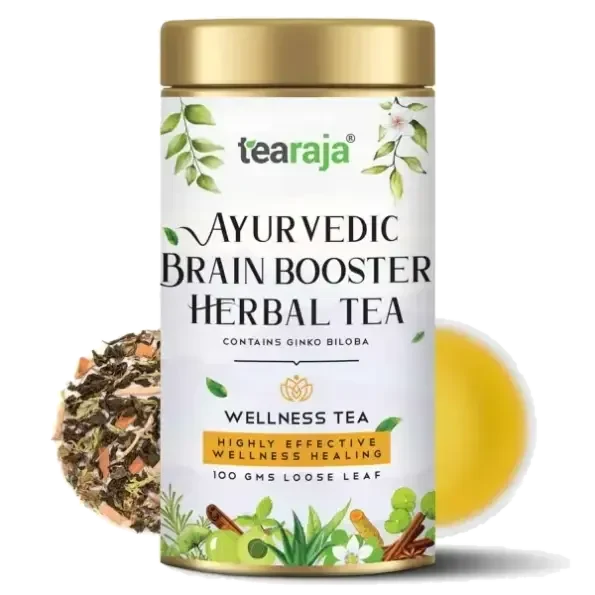
The name printed across the front is Ayurvedic Brain Booster Herbal Tea, under the TeaRaja brand.
I use that name only because it is what the tin says, and I would have chosen a much quieter one.
Under the name, the front of the tin picks out a single ingredient to show you: "Contains Ginko Biloba."
On the back the same plant is spelled correctly, "Ginkgo," which is the kind of slip a proofreader catches and a printer sometimes does not.
Ginkgo is one of the two strangers, and we will get to it.
First, the shelf that most of the seven come from.
The Indian Shelf, Where the Blend Really Lives
The five plants in the second pile are ordinary in India and nearly unknown in an American kitchen.
Holy basil, amla, ashwagandha, brahmi and gotu kola.
All five belong to Ayurveda, the traditional system of Indian household practice that the front of the tin names in its first word.
In that tradition plants are rarely taken one at a time; they are combined, the way a cook combines spices.
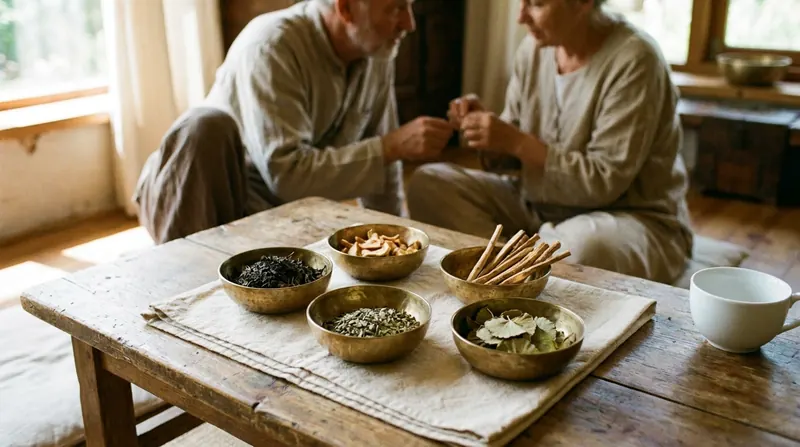
That is worth keeping in mind as we go through them.
The blend is built on a tradition of combining, and the research on these plants is built on testing one at a time.
Those two ways of thinking do not always meet.
Where they do not, I will say so, rather than pretend a trial of one extract speaks for a spoonful of five.
Holy Basil, the Courtyard Plant
Holy basil is the eighth name on the panel.
In India it is called tulsi, and it is grown in pots in courtyards and at the doors of homes and temples.
It is a relative of the sweet basil you might grow for pesto, with a sharper, more peppery, clove-like smell.
In India it is brewed on its own as a tea, which makes it one of the few names on this panel with a long life as a drink rather than a spice.
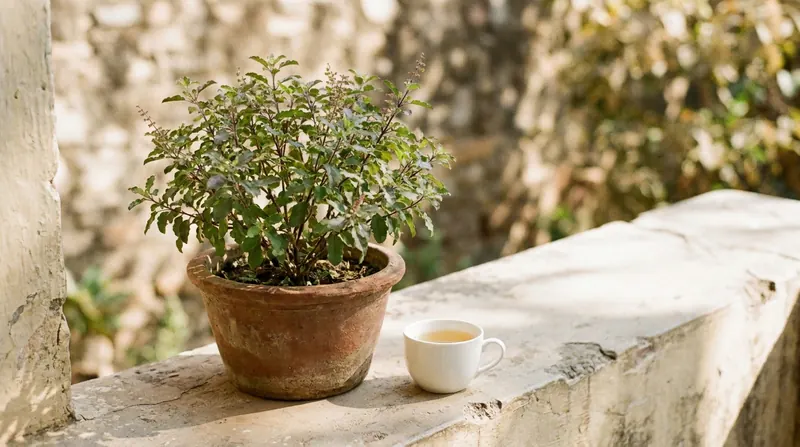
On memory and attention, the honest summary is short.
The reference texts I trust say there are no high-quality studies in people showing holy basil is effective for any health purpose.
So I have nothing to cite for it here, and I am not going to borrow a study from somewhere else.
Holy basil is in this blend for its place in the tradition and its smell, which is reason enough for a tea.
It does carry cautions that belong on the page.
It may lower glucose alongside anything taken daily for glucose, and it may add to bruising and bleeding alongside anything that thins the blood.
It may also lower the level of one of the body's own chemical signals, the one set by the gland that runs your metabolic rate.
It is best avoided in pregnancy, and it goes on the pharmacist list with green tea, ginger and turmeric.
Amla, the Sour Green Fruit
Amla is the fourth name on the panel, and the only fruit.
It is the Indian gooseberry, a small, round, pale-green fruit so sour that it is almost never eaten plain.
In India it goes into pickles, chutneys and candied sweets.
It is also the base of some of the best-known Ayurvedic tonic mixtures, including one sold across India by the jar.
Amla is known as one of the richest food sources of vitamin C.
In a tea, dried pieces of it add a faint sour edge that balances the sweetness of the cinnamon.
On memory and attention, I found no published trial in healthy adults that I would cite.
So amla, like holy basil, is in the cup for tradition and flavor, and I will leave it there.
It is sour and astringent, and large amounts can upset the stomach.
Some reports suggest it can lower glucose, which puts it with holy basil if you take anything daily for glucose.
Ashwagandha, the Root Studied in Much Younger People
Ashwagandha is the tenth name on the panel.
It is a short shrub of the nightshade family, and the part used is the root, dried and cut or powdered.
In India it is sometimes called Indian ginseng or winter cherry.
In the tradition it is usually taken as a root powder stirred into warm milk, not steeped as a tea.
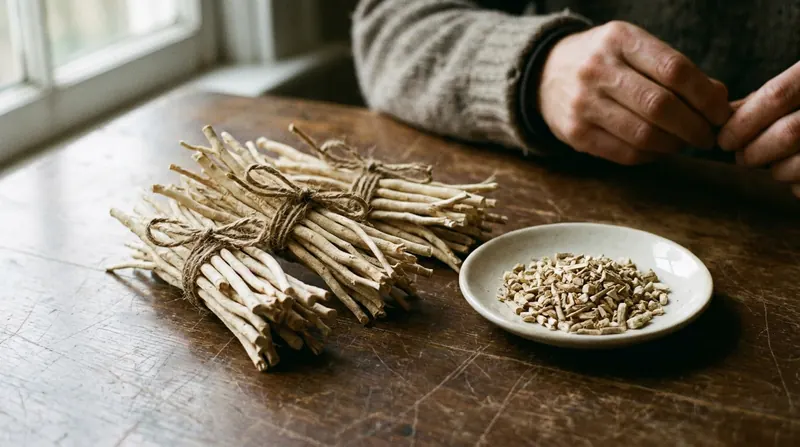
Ashwagandha has more research behind it than most names on this panel.
It is worth reading closely, because the people in it are not the people reading this page.
In one trial, 125 healthy adults aged 20 to 55 who described themselves as under strain took 300 milligrams a day of a sustained-release root extract, or a placebo, for ninety days. [11]
The extract group scored better on memory and focus measures, and rated their nights better, than the placebo group.
In another, 59 young adults with an average age of 23 took 225 milligrams of a root-and-leaf extract, once and then daily for thirty days. [12]
They did better than placebo on some measures of word recall, reaction time and picture recognition.
Both were concentrated extracts, weighed in milligrams and swallowed.
Both were in people decades younger than a man of sixty-five.
The ashwagandha in this tin is dried root in a teaspoon shared with eleven other plants, steeped in water for four minutes.
I cannot tell you how much of it reaches your cup, and I would not expect it to be anything like 300 milligrams of extract.
Ashwagandha carries real cautions.
Rare reports of harm to the organ that processes what you swallow have been described with ashwagandha products.
Stop and speak to your clinician if you ever notice unusual tiredness, dark urine, or yellowing of the skin or eyes.
It is not for use in pregnancy, and it belongs on the pharmacist list if you take anything daily for the body's own chemical signals.
Brahmi, the Name With the Best Trials in the Tin
Brahmi is the sixth name on the panel, and of all twelve it is the one with trials in the right age group.
It is a small creeping plant of wet ground and pond edges across India, with tiny oblong leaves and pale flowers.
In the tradition it is one of the plants most closely associated with memory.
That is the tradition speaking, and for once the research has something to add to it.
Those are two real, placebo-controlled trials, in men and women of the age reading this page.
They are the best evidence for any single name on this tin, and I would not want you to leave without knowing them.
A review that pooled nine such trials found faster performance on two tests of attention speed. [15]
The differences were measured in milliseconds, and the authors called for a large, well-designed trial to settle the question.
Now set those trials beside the tin.
Every one of them used a standardized extract, 300 milligrams a day, for at least twelve weeks.
The tin names brahmi and prints no amount.
It asks you to steep it for four minutes, not to swallow a measured extract every morning for three months.
So brahmi is the strongest name on this panel, and the tin gives you no way to know how much of it is in your cup.
Both halves of that sentence are true at once.
Brahmi's own trials also tell you what to watch for.
The extract groups reported more stomach upset, looser stools, cramps and nausea than the placebo groups. [14]
That was at a daily extract dose far above anything likely in a cup of this blend.
It is still worth noticing how your stomach takes the first week, and stopping if it does not suit you.
Reference texts also advise caution for anyone who takes anything daily for the gland that sets the body's metabolic rate.
Brahmi may slow the heart rate a little, and it can change how the organ that processes what you swallow handles some things people take every day.
Gotu Kola, the Plant That Borrows Brahmi's Name
Gotu kola is the third name on the panel.
It is a small creeping plant with fan-shaped leaves that grows in wet ground from India to Australia.
Across South and Southeast Asia it is eaten fresh, as a salad green or blended into a drink.
And in parts of India it is also called brahmi, which is a different plant.
That shared name causes real confusion on labels.
This tin lists both, separately, so I read it as containing both plants.
Gotu kola's research is thinner than brahmi's and, taken together, less encouraging.
In one small trial, 28 healthy older adults took a gotu kola extract for two months, and only the group on the highest dose, 750 milligrams a day, did better on working memory than placebo. [16]
That trial had seven people in each group.
A review that pooled the randomized trials in 2017 found no significant effect on memory test scores overall, though people did rate themselves as more alert. [17]
I give you both results because they belong together.
A small positive trial and an overall null result is an honest picture of gotu kola, and it is an extract picture, not a tea picture.
Gotu kola has cautions too.
Skin rash has been reported, and rare reports of harm to the organ that processes what you swallow have been linked to gotu kola products.
Five from the Indian shelf. One with real trials, one with a small one, three for tradition.
A Street Tree and a Windowsill Pot
That leaves the two strangers, and they are the oddest names on the panel.
Neither is a spice, neither is from the Indian shelf, and one of them is the plant the front of the tin chose to show you.
Ginkgo is the second name on the panel, straight after green tea.
It is the fan-leaved tree planted along city streets all over the country, the one whose leaves turn a clear butter-yellow in November and drop almost all at once.
It is also a species so old that botanists call it a living fossil.
The dried leaf is what goes into this tea, which is a different thing from the standardized leaf extract used in the research.
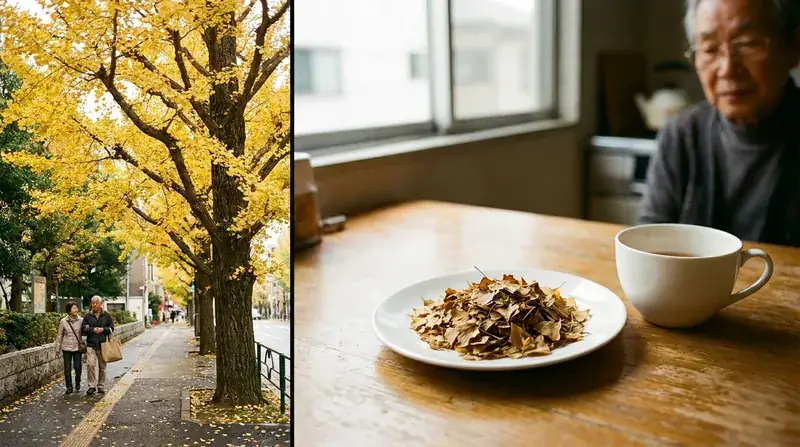
The research on ginkgo extract is large, and the largest trial of all is the one a man of your age most needs to hear about.
It followed 3,069 adults aged 72 to 96 for a median of just over six years. [18]
Half took 120 milligrams of a standardized ginkgo extract twice a day, and half took a placebo.
Their scores on memory, attention and language slipped at the same rate in both groups.
That is 240 milligrams of concentrated extract a day, for six years, in more than three thousand people.
It found nothing.
A smaller trial, of 93 healthy adults aged 55 to 79, went the other way on one measure. [19]
On 120 milligrams of extract a day for twelve weeks, they did better than placebo on one kind of longer-term memory task, and no better on anything else.
One positive result among many measures, in 93 people, set against six years of nothing in more than three thousand.
That is how I would weigh the two, and it is how the government weighs them.
The National Institutes of Health's center for complementary health puts it in a single line: there is no conclusive evidence that ginkgo is helpful for any health condition. [20]
That is a more careful sentence than the front of this tin.
And the ginkgo in your cup is a pinch of dried leaf sharing a teaspoon with eleven other plants.
Whatever it is, it is not 240 milligrams of that extract.
Ginkgo carries one caution worth knowing.
It may add to bleeding in people who take anything that thins the blood, and it should be mentioned before any planned operation.
Aloe Vera, the Plant on the Windowsill
Aloe vera is the seventh name on the panel and the one that surprised me most.
It is the spiky, cactus-like plant many people keep by a sunny window, the one whose clear gel goes on a kitchen burn.
Aloe is sold from different parts of its leaf, and they are not the same thing.
There is the clear inner gel, there is a bitter yellow layer just under the skin, and there is the whole crushed leaf.
The tin does not say which part is in the blend.
That matters, because the bitter yellow layer is a strong laxative, and the gel is the milder part.
On memory and attention, I found nothing linking aloe to either.
It is the one name on this panel that I cannot place in a cup of tea with any confidence, and I would rather say so than guess.
Oral aloe leaf products have been linked to rare cases of harm to the organ that processes what you swallow.
The same three signs apply as with ashwagandha: unusual tiredness, dark urine, or yellowing of the skin or eyes, and any one of them is a reason to stop and call your clinician.
That box is the whole panel on one card, and it is worth reading twice before the practical part of this page.
Four names have something measurable behind them, in some form, in some people.
None of those four was studied as a tea.
And the tin gives you no way to know how much of any of them your spoon is carrying.
The cupboard half is flavor you already know. The far half is where the questions are.
One Teaspoon, and How Much Room Twelve Plants Share
Every jar in your cupboard prints a weight on it, even if it is only the weight of the whole jar.
Recipes give you teaspoons, and a teaspoon of a dried herb is lighter than most people think.
The US Department of Agriculture's food tables list a teaspoon of ground dried sage at seven-tenths of a gram. [21]
I use sage only for scale, because nobody publishes the weight of a teaspoon of this blend.
A spoonful of chopped leaves, roots and bark is heavier than a spoonful of fine powder.
Call it somewhere between two and three grams for a loose, chunky blend like this one.
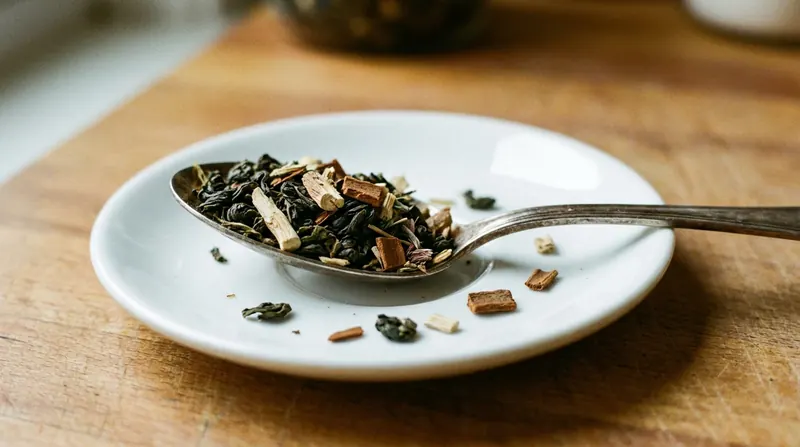
At two grams a spoonful, a 100-gram tin makes about fifty cups.
At three grams, about thirty-three.
The tin does not tell you which, and it does not tell you how many cups it holds at all.
So a single cup a day is something between a month and seven weeks of tea, depending on your spoon.
Now divide that spoonful among twelve names.
If green tea is the largest share, as its place on the list suggests, the other eleven are splitting whatever is left of two or three grams.
That is why no single plant in this tin can be compared with the dose in its own trial.
Brahmi's trials used 300 milligrams of extract a day; the whole spoonful of this blend weighs perhaps ten times that, and most of it is tea leaf.
I am not saying the plants are not there.
I am saying that nobody outside the company can tell you how much of each one is in your cup, and the tin does not try.
The Studies Used Extracts, and This Is a Tea
I have said this sentence several times already, and I want to explain it once, properly, because it is the key to reading everything above.
An extract is made by soaking a plant in a solvent, often water and alcohol, and then concentrating what comes out.
A standardized extract goes a step further and is adjusted so that each batch carries a set amount of the compounds the maker is measuring.
That is what the trials used.
Measured milligrams of a concentrated, standardized product, swallowed every day at the same dose, for weeks or months.
A cup of tea is a different thing altogether.
It is whatever four minutes of hot water pulls out of a spoonful of dried plant, and that depends on the water, the time, the cut of the leaves and how full the spoon was.
Some compounds come out readily into hot water.
Others barely come out at all, and some of the compounds in turmeric are famously poor at it.
Nobody has measured what a cup of this blend delivers.
Not the seller, not the packer, and not any study I could find.
So the fair reading is this: the plants in the tin have research, and the tin itself has none.
That is not unusual for a herbal tea.
It is simply the honest position, and I would rather you order a tin knowing it than be surprised by it later.
Brewing It the Way the Tin Asks
The tin's own directions are short, and they are printed on its side rather than on the seller's listing.
One teaspoon of the blend to a cup of boiled water, cover it with a lid, steep for three to four minutes, strain and drink.
The lid is the one step a cook will recognise from making any herb tea.
Covering the cup keeps the aromatic part of rosemary, holy basil and cinnamon in the cup instead of in the kitchen air.
Three to four minutes is ordinary for green tea.
Longer, and the green tea starts to turn bitter; shorter, and the roots and bark have barely started.
Use water just off the boil, as the tin says, and a level spoon rather than a heaped one.
The rosemary trial is a good reason to resist making it stronger in the hope of doing more.
And drink it early in the day.
The green tea in it carries caffeine, and the tin does not print how much, so the evening is the wrong end of the day for it.
Storage, a Cupboard Question the Tin Answers Twice
A spice jar lives in a cupboard, and nobody thinks twice about it.
This tin, oddly, cannot quite decide where it wants to live.
The same panel that carries the directions says, "Always use a dry spoon, store in a cool, dry & hygienic place."
A few lines further on it says, "Store under refrigeration."
Those two instructions do not agree, and I cannot tell you which one the packer meant.
The panel also asks you to keep the tin away from products with a strong smell, and gives a best-before of 24 months from packing.
For what it is worth, a cool, dark cupboard away from the stove is how most people keep loose tea.
A refrigerator brings the risk of damp every time a cold tin is opened in a warm kitchen, and damp is what loose leaf likes least.
The dry-spoon line is the most useful one on the panel.
A wet spoon dipped in a tin of dried leaves and roots is the quickest way to spoil it.
Who Sells the Tin, From Where, and What Happens If It Goes Wrong
Your spice jars came from a store down the road, and if one was wrong you could take it back.
This tin comes from the other side of the world, and the terms are very different.
The tin is packed and marketed by FY Wellness Private Limited, whose address in Kolkata is printed on its side.
It is sold by Herbkart Commerce Inc., an online store in Chennai that sells its own products and other companies' products on the same site.
The seller's listing names the manufacturer as Tearaja Private Limited, while the tin names FY Wellness as the packer.
I report both as printed, without guessing at how the two companies are related.
Herbkart's contact page gives a phone number for WhatsApp and Signal, +91 85969-79989.
Its privacy page gives an email address, talk@herbkart.com, and its contact page gives a street address in Anna Nagar East, Chennai.
Shipping is worldwide at no extra cost, with no minimum order, according to the seller's shipping page.
The listing says the tin typically leaves within one to two days.
What the shipping page does not give is a delivery time to the United States.
It says parcels travel by international post and courier, with tracking by email, and it stops there.

It also says, plainly, that buyers are responsible for any customs and import charges.
If a parcel is refused or held at customs, the seller does not refund it.
Now the part I would read twice before ordering.
The seller's returns page says, in so many words, "International returns are not accepted."
A claim is possible within thirty days of delivery, but only if the order was wrong, damaged in transit, expired or incomplete.
And the seller asks for an unboxing video as a condition of any claim.
If the seal on the tin has been opened, the seller says it cannot issue a refund.
Complaints about taste or quality are passed to the maker rather than handled by the store.
An order can be cancelled for a full refund only within 24 hours of placing it.
After that, and once the parcel arrives in good order, a buyer in the United States should expect to keep the tin whether he likes it or not.
Order it the way you would order anything from abroad: knowing it will not be going back.
None of this is tucked away; it is all on the seller's own pages.
I set it out here because most readers never open a returns page until they need one.
Why This Page Quotes No Buyers
When I checked the seller's listing on September 21, 2026, it showed no reviews at all.
Not a poor rating, not a mixed one, simply none.
So there are no customer quotes on this page, and there will not be.
I will not write one, borrow one from another product, or dress up a stock photograph as a happy buyer.
That leaves you with the panel, the research on the plants and your own taste to go on.
It is less than a column of five-star reviews, and it is a great deal more honest than an invented one.
The Cautions, Gathered From Every Jar at Once
I have mentioned the cautions plant by plant, and they are easy to lose that way.
Here they are together, the way you would want them if you were carrying the tin to a pharmacist.
- Caffeine from green tea, in an amount the tin does not print: keep it to the daytime, and count it with your coffee. [2]
- Green tea can make some things people take daily work less well, and harm to the organ that processes what you swallow has been reported, mostly with concentrated extracts. [1]
- Ginkgo, ginger and turmeric may each add to the effect of anything that thins the blood.
- Holy basil and amla may lower glucose alongside anything taken daily for glucose.
- Holy basil, brahmi and ashwagandha may each affect the body's own chemical signals, and are best checked if you take anything daily for them.
- Ashwagandha, gotu kola and aloe have rare reports of harm to the organ that processes what you swallow; stop if you notice unusual tiredness, dark urine, or yellowing of the skin or eyes.
- Cassia cinnamon carries coumarin, and the tin does not say which cinnamon it uses.
- Holy basil and ashwagandha are best avoided in pregnancy.
- The tin says it was packed in a facility that also processes nuts.
That is a long list for a cup of tea, and I do not want it to sound louder than it is.
Most of these cautions come from concentrated products at far larger amounts than a spoonful shared twelve ways.
But the tin gives no amounts, so neither you nor your pharmacist can do the arithmetic.
That is exactly why the conversation is worth having before the tin becomes a daily habit.
Put everything you take daily in one bag with the tin, and ask your pharmacist whether anything in the bag argues with the list above.
Cheaper Things From the Same Cupboard
If you have read this far because a slipping name or a lost word has been nagging at you, there are things in your own kitchen that cost less than a tin from Chennai.
None of them is sold by anyone, and all of them have more behind them than any tea.
The first is a glass of plain water.
In a Berlin study of 1,111 adults aged 60 to 89, those who were measurably short of water did worse over time on a test of processing speed. [22]
A review of eighteen studies of adults over 60 found some, though sparse, evidence tying dehydration to poorer thinking scores. [23]
It is observational, and it is still the cheapest habit on this page.
The second is the pattern of what you eat over years, not any single thing in the cupboard.
In a three-year trial of 604 older adults, the group eating a leafy, bean-and-berry pattern and a group that simply ate a little less both improved their thinking scores, by about the same amount. [24]
And in a Brazilian study of more than ten thousand adults, those who ate the most from the packaged, heavily processed shelf slipped somewhat faster on tests of memory and thinking over about eight years. [25]
Plain oats, beans, greens and a handful of nuts are cheaper than most of that shelf.
The third is your hearing and your eyesight.
A man straining to hear a conversation or read a label can look, even to himself, a great deal like a man who is not remembering.
The fourth is a walk, most days, and the fifth is a conversation with someone you like.
Neither can be shipped from anywhere.
The cupboard was always the cheapest part of this.
Who This Tin Suits, and Who Should Leave It on the Shelf
This tin suits a man who likes spiced green tea and wants the whole blend, not just the familiar half.
He knows the seven plants he cannot buy locally are the point, and he is happy to have them cut and mixed for him.
It suits a man who wants a warm daytime cup and a few minutes at the table, and who counts the caffeine with his coffee.
And it suits a man who reads the terms before ordering and is comfortable that the tin will not be going back to India.
It is not for a man who wants a measured dose of any particular plant.
The tin prints no amounts, and a brahmi or ginkgo extract would be a different product altogether.
It is not for a man who takes anything daily that might argue with green tea, ginkgo, holy basil or turmeric, until his pharmacist has seen it.
And it is not for anyone who wants an evening cup, because of the caffeine.
And it is not for a man whose worry about his memory has been with him for months, on good days and bad.
That man's first step is his own clinician, and a tin of tea from anywhere is at best a pleasant second.
The Tin, and the One Place That Sells It
If you have read this far and still want to see the tin, there is one place this page will send you.
It is the seller's own listing on Herbkart, which shows the price in dollars and in other currencies on the day you look.
I print no price here, because the seller sets it and changes it.
Look at the price and the shipping line on the listing itself, and then add any customs charge in your head, because the seller will not add it for you.
The twelve names on the tin, in the order it prints them, with what each plant is, what the research says about it and the cautions for each one, are written out in the ingredient guide linked at the foot of this page.
The references in full and the disclosures this page is required to make are there too.
Seven plants your cupboard lacks, in one 100-gram tin
A loose-leaf blend of green tea and eleven Indian herbs and spices, one teaspoon steeped for three to four minutes, packed in Kolkata and sold from Chennai.
SEE THE TIN WITH THE OTHER SEVENSold by Herbkart Commerce Inc., Chennai, India · 100 g loose leaf, one teaspoon a cup · carries caffeine from green tea · shipping at no extra cost; customs charges are the buyer's · international returns are not accepted
Short answers about the tin and the cupboard
Is this a medicine?
No. It is a loose-leaf herbal tea sold as a food, and it is not meant for any medical condition.
Which of the twelve plants will I already have at home?
Green tea, rosemary, ginger, cinnamon and turmeric are sold in any supermarket.
Does it contain caffeine?
Yes, from green tea, its first ingredient. The tin does not print the amount, so keep it to the daytime.
How much brahmi or ginkgo is in a cup?
Nobody outside the company can say. The tin prints twelve names and no amounts.
How many cups are in a tin?
The tin does not say. At two to three grams a teaspoon, roughly thirty-three to fifty.
Should I ask anyone before drinking it every day?
Yes, your pharmacist, if you take anything daily. Green tea, ginkgo, holy basil and turmeric each carry cautions.
Can I send it back if I don't like it?
No. The seller does not accept international returns; claims are only for wrong, damaged, expired or incomplete orders, with an unboxing video.
Why are there no reviews?
The seller's listing had none on September 21, 2026, so none are quoted.
The Whole Cupboard, in Twelve Lines
- A 100-gram tin of loose-leaf herbal tea, packed in Kolkata by FY Wellness Private Limited and sold from Chennai by Herbkart Commerce Inc., as a food.
- Twelve names on the panel, green tea first, and no amount printed for any of them.
- Five from any kitchen cupboard: green tea, rosemary, ginger, cinnamon and turmeric.
- Five from the Indian shelf: holy basil, amla, ashwagandha, brahmi and gotu kola.
- Two strangers: ginkgo, the street tree, and aloe, the windowsill plant, with no word on which part of the leaf.
- Green tea carries caffeine the tin does not count; the FDA cites 400 milligrams a day as not generally associated with negative effects in healthy adults. [2]
- Rosemary's one study used dried leaf at close to a kitchen amount, and eight times as much went the other way. [8]
- Brahmi's two trials used 300 milligrams of extract a day for twelve weeks in adults over 55 and over 65. [13] [14]
- The largest ginkgo trial, 240 milligrams of extract a day for six years in 3,069 adults, found nothing. [18]
- The research on these plants used extracts, and this is a tea.
- Storage: a cool, dry place and also under refrigeration, on the same panel.
- Shipping at no extra cost, customs charges on the buyer, no international returns, and no reviews on the listing.
Closing the Cupboard Door
Here is the whole thing the way I would say it standing at an open cupboard.
This is a spiced green tea from India, made with a teaspoon, a lid and a few minutes, from a tin that names twelve plants and weighs none of them.
Five of those plants are already on your shelf, and you could brew something close to that half tonight.
The other seven are what the tin really sells, and two of them, brahmi above all, have trials worth knowing, in extract form.
The plant printed on the front of the tin has the largest trial of all, and it found nothing.
And the most practical fact a buyer needs, that the cup carries caffeine, is nowhere on the tin.
What the tin gives you, reliably, is a warm, spiced, caffeinated cup with seven plants in it that your cupboard does not have.
For some men that is worth a parcel from Chennai, and for some it is not.
If you are one of the first kind, buy one tin, make it the tin's way at the same hour for two weeks, and see whether it earns a place on the shelf.
Order knowing the parcel will not go back to India if you change your mind.
If you are one of the second kind, the cupboard is already open.
A spoonful of green tea, a slice of ginger and a sprig of rosemary will give you the familiar half for the price of what is already in the jars.
Either way, the kettle is the same kettle.
Twelve plants in one tin, sent from Chennai
A loose-leaf blend of green tea and eleven Indian herbs and spices, one teaspoon steeped for three to four minutes, packed in Kolkata and sold from Chennai.
SEE THE TIN WITH THE OTHER SEVENHerbkart Commerce Inc., Anna Nagar East, Chennai, India · WhatsApp and Signal +91 85969-79989 · talk@herbkart.com · international returns are not accepted · customs charges are the buyer's
P.S. If you keep two facts from this page, keep these.
The research on these plants used concentrated extracts in measured milligrams, and a cup of tea is whatever a few minutes of hot water pulls out of a teaspoon.
And the cup carries caffeine from green tea, in an amount the tin does not print, so it belongs to the first half of the day.
P.P.S. If a worry about your own memory has been with you for months, speak to your own clinician before you order anything at all.
A tin of tea was never going to answer a question that a proper appointment can.